
Columbia County Criminal Records
A Columbia County criminal court record is the court case file kept after criminal charges are filed and the case is opened in the court system. It can include the formal information or complaint, arraignment events, pleas, motions, hearings, trial activity, verdict or plea outcome, disposition, sentence, financial obligations, probation terms, warrants, and bench warrants. The Clerk of Courts function supports criminal filings for the Columbia County Court of Common Pleas. Magisterial District Courts create lower-court criminal, summary, traffic, and preliminary hearing docket records.
The Court of Common Pleas handles major criminal cases after preliminary proceedings, while Magisterial District Courts handle preliminary arraignments, preliminary hearings, summary offenses, and traffic matters. Columbia County is part of the 26th Judicial District with Montour County. A criminal court record can begin in an MDJ office and later continue in Common Pleas. For the charges themselves and the arrest-to-charge path, use Arrest Records & Charges. For the broader set of civil, family, probate, traffic, and criminal records, use Court Records.
The Columbia County District Attorney page identifies the prosecutor's office and links local criminal workflow forms.
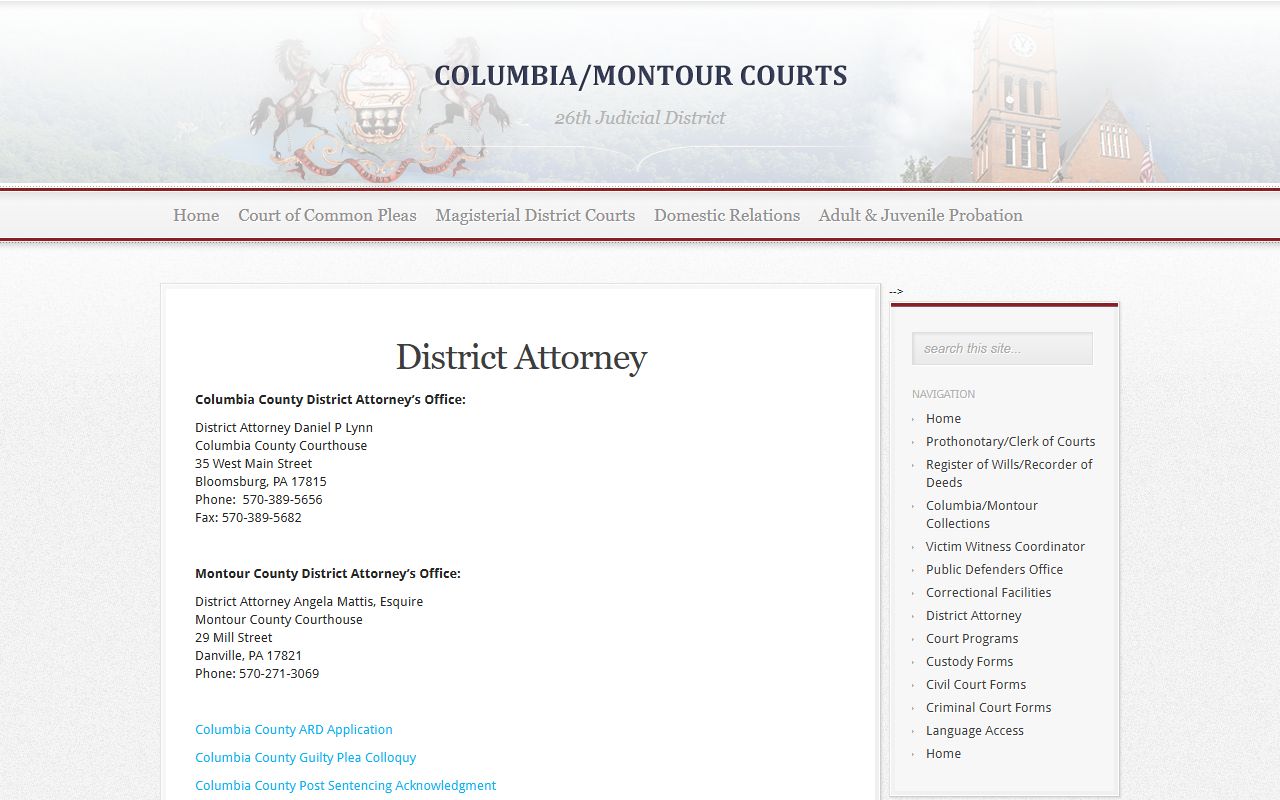
The District Attorney connection matters because the prosecutor files and manages many criminal charging and plea-stage documents that later appear in the court record.
Search Columbia County Criminal Cases
The main search channel is Pennsylvania UJS Case Search. It covers web docket sheets for Court of Common Pleas and Magisterial District Court matters. Search by docket number if it is known. Name searches can work, but spelling, middle initials, date filters, and court filters affect results. Criminal records may also be searched by OTN, police incident or complaint number, and SID when those values are available.
- Open UJS Case Search and select the criminal docket level that matches the case.
- Use the docket number for the most exact result, or search by defendant name, OTN, police incident number, complaint number, or SID.
- Narrow the court or county field to Columbia or Columbia/Montour options when the portal offers that filter.
- Open the docket and review charges, docket entries, pleas, hearings, disposition, sentence, and financial details.
- Contact the Clerk of Courts when a certified copy, older file, complex request, or non-public item needs clerk review.
PAeDocket is also available as a free mobile app through the Unified Judicial System portal. PAePay can help with payment-eligible traffic, summary, criminal, fines, costs, restitution, and payment-plan obligations. Neither one replaces the official criminal-history background check route. Pennsylvania docket warnings state that web docket sheets are not criminal-history background checks and that those checks come from Pennsylvania State Police.
Criminal Case Stages
A Columbia County criminal record changes as the case moves. Early entries may show a complaint, arrest-related docket data, arraignment, bail, and preliminary hearing events. If the case is held for court, the Common Pleas record may show a criminal information, formal arraignment, motions, plea discussions, trial events, sentencing, restitution, fines, costs, probation, and post-sentence matters.
Case flow: Charges Filed › Arraignment › Pretrial / Motions › Plea or Trial › Disposition › Sentencing
| Stage | What Happens |
|---|---|
| Charges Filed | The complaint or criminal information places accusations into the court case record. |
| Arraignment | The defendant is advised of the case and the court records plea or scheduling activity. |
| Pretrial / Motions | Attorneys file requests, continuances, suppression motions, discovery matters, and other case actions. |
| Plea or Trial | The case resolves by plea, trial verdict, dismissal, withdrawal, or another disposition event. |
| Sentencing | The court records jail, probation, fines, costs, restitution, and conditions when a sentence is imposed. |
The Columbia County Public Defender page gives the local route for eligible defendants who cannot afford counsel.
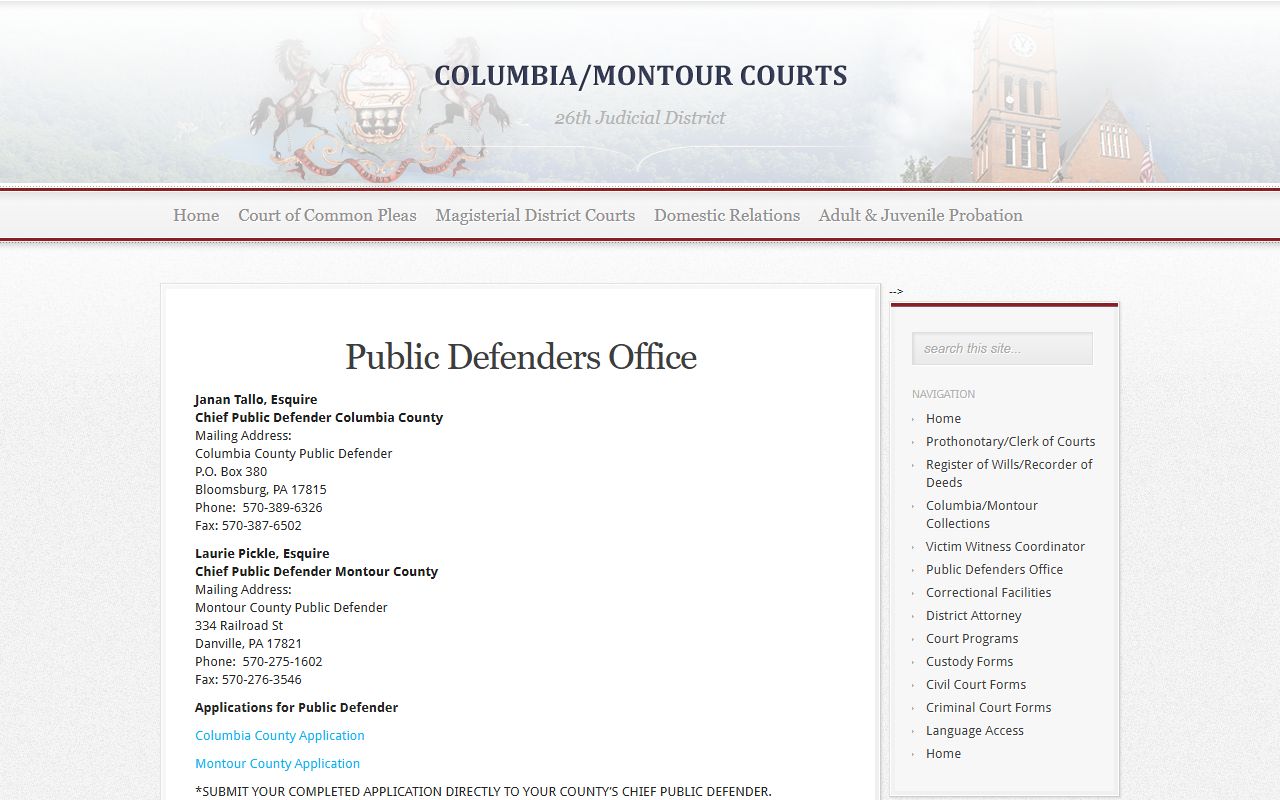
Public Defender materials are not public court records, but counsel status can shape motions, hearings, pleas, and docket entries in a criminal case.
Columbia County Criminal Record Fields
The criminal case file is more detailed than a single charge list. It can show who is accused, what charges were filed, what court handled the matter, whether counsel appeared, what hearings occurred, and how each charge ended. It may also show bail or bond events, a surety, bench warrants, costs, restitution, payment-plan data, and links back to a lower-court docket.
| Field | What It Shows |
|---|---|
| Case Number | The Common Pleas or MDJ docket number used to identify and search the case. |
| Defendant | The person charged, with role labels and sometimes other tracking identifiers. |
| Charges | Each accusation, statute or charge text, severity, and current status when shown. |
| Plea | The defendant's formal answer to one or more charges. |
| Disposition | The result of a charge or case, such as guilty, dismissed, withdrawn, or acquitted. |
| Sentence | Jail, probation, fines, costs, restitution, and court-ordered conditions where applicable. |
| Docket Entries | The chronological filing and event list for motions, orders, hearings, and case activity. |
Note: A web docket can be enough to track status, but official uses may require a certified copy from the court custodian.
Charges vs. Convictions
A criminal charge is an accusation. A conviction is a final result after a guilty plea, guilty verdict, or other conviction event. Columbia County criminal court records may show charges that were later dismissed, reduced, withdrawn, or resolved by a plea to different counts. That is why each charge line should be read with its status and disposition, not just the first accusation that appears on the docket.
| Charge | Conviction | |
|---|---|---|
| Meaning | An accusation filed into the court record. | A final guilt-based outcome by plea or verdict. |
| Timing | Appears early and may change. | Appears after disposition or sentencing events. |
| Record Reading | Check amended, reduced, dismissed, or withdrawn status. | Check sentence, restitution, probation, and financial entries. |
Dispositions and Sentences
Disposition means the outcome of a charge or case. In a Columbia County criminal record, disposition entries must be matched to each charge because one docket can contain several counts with different results. Sentencing entries may include incarceration, probation, fines, costs, restitution, payment terms, and court-ordered conditions. A sentence can also point to later supervision, violation, payment, or bench-warrant activity.
The District Attorney page links Columbia County ARD Application, Guilty Plea Colloquy, Post Sentencing Acknowledgment, and directions to complete CRN and full assessment. ARD can be relevant to eligible criminal cases because it may resolve charges without a conventional conviction after program conditions are met, but eligibility and approval are handled by the DA and the court.
Sealed vs. Expunged Records
Some criminal court records are not fully public. Pennsylvania distinguishes expungement from limited access or sealing. Expungement removes eligible arrest or conviction data from a criminal record. Limited access shields eligible records from public view while leaving access for law enforcement and judicial officers. A person reviewing Columbia County criminal records should compare the court docket with the Pennsylvania State Police record before deciding what relief, if any, may apply.
| Sealed or Limited Access | Expunged | |
|---|---|---|
| Public Visibility | Shielded from public access under rule or order. | Removed or destroyed under an expungement process. |
| Government Access | May remain available to courts, law enforcement, or authorized users. | Very limited, depending on the legal basis for expungement. |
| Common Path | Clean Slate or a court order where eligible. | Petition, qualifying dismissal, acquittal, summary eligibility, pardon, or ARD path where supported. |
Public Access to Criminal Records
204 Pa. Code § 213.81 is the Case Records Public Access Policy. It generally routes public access through the court custodian while recognizing confidentiality rules and remote-access limits. For Columbia County criminal records, simple inspection or copy requests may be oral, but the custodian may require a written request for complex or voluminous records.
Key access rules:
204 Pa. Code § 213.81 governs Pennsylvania court case record access and defines what case records include.
18 Pa.C.S. § 9101 et seq. is the Criminal History Record Information Act referenced by docket warnings for criminal-history use.
The Pennsylvania Auditor General court-office audit page identifies Columbia County court office functions tied to Common Pleas, the Prothonotary, and Orphans' Court records.
That audit context reinforces the local split between civil, criminal, and Orphans' Court record functions in Columbia County.
Background Check Considerations
Criminal court records can be useful for public case review, but they are not the same as a Pennsylvania State Police criminal-history background check. Dockets can be delayed, incomplete, amended, or limited by court rule. Employers, landlords, insurers, and other regulated users should not treat casual docket review as a consumer report or official background check.
Important: Public docket review is not an FCRA consumer report and should be verified with the originating government office.
Restricted Columbia County Criminal Records
Restricted criminal records can include sealed records, expunged records, limited-access cases, juvenile matters, confidential information forms, confidential document forms, Social Security numbers, financial account numbers, driver's license numbers, SID numbers, and some minor-related information. An online docket may show less than the courthouse file, and the courthouse file may still withhold confidential documents from public inspection.
For custody status, use Inmate Records. For active warrant posts, use Warrant Records. Criminal court records answer a different question: what the court has filed, heard, decided, ordered, and recorded in the criminal case.